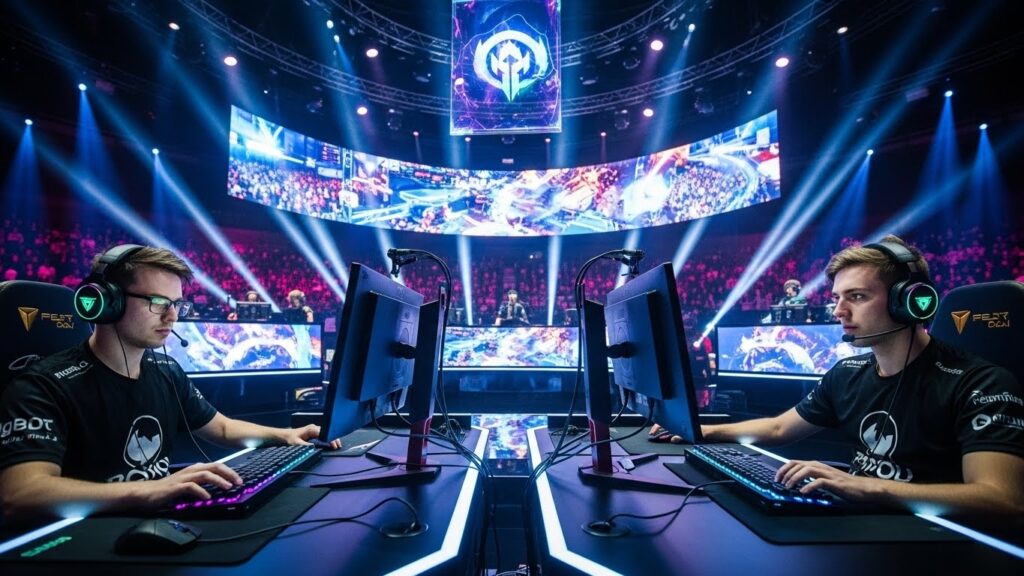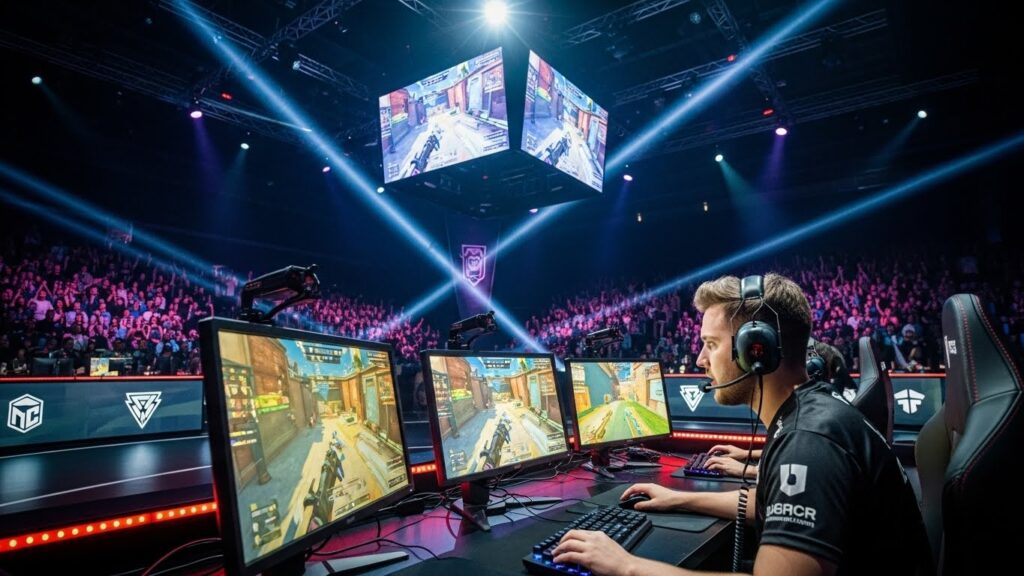
Esports has evolved from small local gatherings of gamers to a full‑blown global phenomenon. In just a couple of decades, competitive gaming has transcended hobbyist circles and captured mainstream attention. What once was limited to basements, LAN parties, and niche communities is now filling arenas and drawing millions of viewers worldwide. In this article, we explore the journey of esports, its current scale, the challenges it faces, and what the future might hold.
Origins of Competitive Gaming
Competitive gaming is not a new concept. In the early days of video games, players would challenge each other locally, keeping score on arcade leaderboards or hosting small tournaments among friends. But the first signs of organized competitive gaming began to appear in the 1980s and 1990s, with early competitions held for games like “Space Invaders,” “Street Fighter,” and “StarCraft.” These events were mostly small, grassroots, and often informal.
By the late 1990s and early 2000s, online multiplayer infrastructure improved, allowing gamers to compete with one another across cities and countries. Titles such as “Counter‑Strike,” “Quake,” and “Warcraft III” became staples of early esports competitions. Small expos and conventions would host side tournaments, and prize money was modest, often funded by local sponsors or the gaming communities themselves.
Explosion of Growth
From the late 2000s onward, esports began to grow rapidly. Several factors contributed to this acceleration:
- Improved Internet and Infrastructure
As broadband access became widespread, lag and connection issues diminished. Players from distant locations could compete with minimal delay, enabling smoother, fairer competition. - Streaming Platforms
The advent of livestreaming opened a new way for people to watch content in real time. Esports events could now be broadcast to audiences anywhere in the world. Commentary, interactive chat, and monetization through subscriptions and ads made spectator gaming viable. - Professionalization and Investment
Organizations began forming professional teams, hiring coaches, analysts, fitness trainers, and staff. Sponsors recognized the growing audience and invested in teams and tournaments. Prize pools ballooned accordingly. - Global Reach
What was once concentrated in a few countries expanded regionally. Asia, Europe, North America, Latin America, and increasingly Africa all developed vibrant esports scenes. Regional leagues and localized content made it accessible in many markets. - Mainstream Media and Recognition
Esports began being covered by mainstream media outlets. Some cities and countries started supporting esports infrastructure. Universities introduced esports scholarships, and governments acknowledged esports as a legitimate profession.
Because of these forces, esports is no longer niche. It is an industry projected to generate billions in revenue, with millions of passionate fans tuning in to watch tournaments across multiple game genres.
The Esports Ecosystem
To understand how esports functions, one must look at its major components: game publishers, tournament organizers, teams and players, streaming platforms, sponsors and investors, and fans.
Game Publishers
The publisher (or developer) of a game holds much of the decision-making power. They determine patch schedules, rulesets, in‑game balance, licensing, and sometimes which tournaments receive official support. Games like League of Legends, Dota 2, Counter‑Strike, Overwatch, Valorant, and Fortnite each have distinctive ecosystems shaped by their publishers’ strategy.
Some publishers host their own leagues (often “official circuits”) and control revenue distribution, while others license third parties to run competitions. Their policies on monetization, game updates, and tournament support can make or break an esports scene.
Tournament Organizers
These are the groups that run events: local qualifiers, regional leagues, open tournaments, and global finals. Organizers handle logistics, broadcasting, prize money, rules enforcement, talent (casters, hosts), production, and marketing. To succeed, they must coordinate with publishers, teams, sponsors, and venues.
Major organizers often run multi‑tier circuits: amateur stages feeding into pro leagues, culminating in international events. Some run large seasonal leagues, others focus on one‑off championships, and some mix both.
Teams and Players
Professional players often form teams, which provide support in multiple dimensions. A modern esports team has a roster of players, substitute players, coaching staff, analysts, physical trainers, and even mental performance specialists. Teams handle contracts, salaries, housing, and logistics. In return, they share in tournament winnings, streaming revenue, sponsorships, and merchandising.
Players must combine mechanical skill (fast, precise control), game knowledge (strategy, meta awareness), teamwork, mental resilience, and often brand presence. At the top levels, the margin between winning and losing is razor thin—tiny mistakes can decide matches.
Streaming and Broadcasting Platforms
Streaming platforms are the lifeblood of audience reach. Events are broadcast live, sometimes with multiple camera feeds, player POV views, replays, slow motion, and expert commentary. The interactivity of chat, donation alerts, and overlays make the experience dynamic.
Beyond tournaments, many professional players and teams run regular content on their own channels—practice sessions, interviews, casual matches, behind‑the-scenes glimpses. This helps maintain engagement between events and grows fan loyalty.
Sponsors, Brands, and Investors
Sponsors provide financial backing, branding exposure, and legitimacy. They can be tech companies, energy drink brands, apparel companies, telecom firms, automotive brands, or non‑endemic sponsors like banks and insurance. Their interest is tied to reach, demographics (young, digitally native audiences), and brand alignment.
Investors look at esports as a growth industry. Some fund teams, leagues, broadcasting infrastructure, or content ventures. As the esports economy grows, the stakes and expectations rise too.
Fans and Community
Without fans, esports would not exist. The community supports teams through viewership, subscriptions, merchandise purchases, social media engagement, and grassroots events. Local scenes emerge from colleges, gaming cafes, high schools, and community centers.
Fans are often highly engaged—they predict match outcomes, debate strategies, analyze meta changes, and create content themselves, such as podcasts, YouTube videos, fan art, or community tournaments.
Popular Esports Titles and Genres
Esports covers multiple game genres, each with its own audience, pace, and structure. Below are the major ones and some prominent titles.
Multiplayer Online Battle Arena (MOBA)
Games in this genre feature teams controlling heroes or champions, battling to destroy the enemy base. Significant titles:
- League of Legends: One of the biggest esports globally, with annual world championships that attract tens of millions of viewers.
- Dota 2: Known for its steep learning curve and massive prize pools (especially at “The International”).
MOBAs emphasize teamwork, deep strategy, and long match duration. They have layered dimensions—drafting, item builds, rotations, macro play.
First‑Person Shooters (FPS)
FPS esports are fast, reaction‑based, and require precise aim, map control, and split‑second decision making. Examples:
- Counter‑Strike: Global Offensive / Counter‑Strike 2: Tactical team shooter with bomb planting/defusal modes and strong team dynamics.
- Valorant: Combines tactical shooting with agent abilities, adding a strategic layer.
- Overwatch: Hero shooter with team composition and roles influencing gameplay.
FPS tournaments are popular for their high intensity and thrilling plays.
Battle Royale
In this genre, many players or teams compete to be the last one alive. It’s a mix of survival, looting, and combat. Titles include:
- Fortnite
- PlayerUnknown’s Battlegrounds (PUBG)
- Apex Legends
These tend to have more variance, unpredictable outcomes, and can be more viewer‑friendly at times due to dramatic moments.
Real-Time Strategy (RTS)
Early esports stalwarts fall under RTS. Although less dominant now, they remain influential. Examples:
- StarCraft II
- Warcraft III
RTS titles emphasize resource management, macro and micro control, and intense decision making under pressure.
Sports Simulations, Fighting Games, and Others
- FIFA / EA Sports titles: simulate football (soccer) competitions.
- NBA 2K: basketball simulation.
- Street Fighter / Super Smash Bros. / Tekken: fighting games that are staples in arcades and casual scenes.
- Rocket League: hybrid of sports and vehicles, accessible yet competitive.
Each of these draws dedicated fans and hosts leagues of varying scale.
Major Events That Shaped the Industry
Certain tournaments and moments stand out as transformative for esports.
The International
Dota 2’s annual world championship is legendary for its prize pool, largely crowdfunded by players through in-game purchases. It has shattered records for esports payout and created global buzz around Dota 2.
League of Legends World Championship
LoL worlds is more than a tournament—it’s a cultural event with opening ceremonies, performances, and global viewership. It has become comparable to traditional sports finals in scope.
Counter‑Strike Majors
Counter‑Strike’s Majors—sponsored by Valve—are highly prestigious tournaments with rigorous qualification and high viewership. They bring together top teams from all regions.
Mid‑Season and Regional Leagues
Organizers and publishers developed regional leagues (e.g. North America, Europe, Korea, China) and mid‑season tournaments to build continuous engagement rather than only seasonal peaks. These allow consistent competition, talent development, and regional identity.
Collegiate and University Leagues
Universities around the world began forming esports teams and offering scholarships. Collegiate tournaments serve as feeder systems, helping identify rising talent.
These events not only award large sums but also serve as media spectacles, drawing global attention to esports’ legitimacy.
Business Models and Revenue Streams
The esports ecosystem supports a variety of revenue streams. Below are key ones:
Sponsorships and Advertising
Sponsors pay teams, tournaments, and broadcasters for exposure—brand placements, in‑game overlays, jersey logos, product placement. As audiences grow, sponsorship revenue often forms a major portion of income.
Media Rights and Broadcasting Fees
Just like traditional sports, broadcasting rights (licensing tournaments to media networks or streaming platforms) generate revenue. Tournament organizers may charge for exclusive livestream rights or partner with platforms.
Ticket Sales and Onsite Revenue
Major tournaments now sell tickets to spectators. Merchandise booths, concessions, VIP packages, and in‑arena experiences augment income.
Merchandise and Apparel
Fans purchase jerseys, hoodies, hats, and game‑themed gear. Teams and publishers often launch limited edition items, drops, and collaborations.
Digital Goods and In‑Game Purchases
Publishers can monetize via skins, battle passes, cosmetic items, and subscriptions. A portion of this revenue may be shared with esports organizations or funnel toward prize pool crowdfunding.
Publisher Support and Licensing
In some ecosystems, the publisher directly funds parts of the esports scene—league infrastructure, prize pool contributions, marketing support. Licensing fees for tournament organizers or teams may also apply.
Player Streaming and Content
Pro players often stream on their own channels. They earn via subscriptions, donations, sponsorship during streams, ads, and affiliate programs. This keeps them engaged with the fanbase outside tournaments.
Investment, Equity, and Media Ventures
Teams, media platforms, and esports infrastructure can attract external investment. Some organizations become content houses, producing videos, documentaries, or esports adjacent products.
Through this diversity, the industry can sustain itself despite volatility in one revenue area.
Challenges Facing Esports
Even as esports thrives, it is not without issues. The path to long‑term sustainability requires overcoming several challenges.
Player Burnout and Wellbeing
Esports professionals often endure intense practice schedules, long hours, frequent travel, and high stress. Physical and mental health issues like repetitive strain injuries, poor sleep, and anxiety are common. Balancing rigorous training with rest and recovery is critical.
Regulatory and Legal Issues
Compensation, contract disputes, regional regulations, gambling regulations, and age restrictions pose legal complexity. Some countries lack clear recognition for esports, complicating visas for international contestants.
Match Fixing, Cheating, and Integrity
Maintaining integrity is vital. Instances of match fixing, cheating (e.g. hacking, unauthorized software), or illicit betting undermine trust. Organizers must invest in anti‑cheat technology, monitoring, and robust regulatory frameworks.
Regional Disparities
While some regions enjoy strong infrastructure and investment, others lag due to limited internet, funding, or cultural acceptance. This imbalance can hinder talent from less privileged areas. Bridging this gap is an ongoing struggle.
Publisher Dependence
Teams and organizers heavily rely on publisher decisions. Changes to a game’s balance, reduced esports support, or shifts toward new titles can destabilize entire ecosystems. Diversification is difficult.
Monetization without Alienation
While monetization is necessary, overcommercialization (ads, intrusive overlays) risks alienating fans. Striking the balance between revenue and fan experience is delicate.
Sustainability of Prize Pools
Some tournaments rely heavily on crowdfunded revenue or large sponsor injections. Ensuring stable prize pools without overreliance on external hype is a challenge for long‑term planning.
Stories of Remarkable Teams and Players
The heart of esports lies in its human stories: players who train obsessively, underdogs rising to fame, teams with legendary rivalries, and personal sacrifices made for competitive glory.
Consider a professional Dota 2 roster that clawed its way from open qualifiers to top rankings, outwitting favored teams and becoming beloved underdog heroes. Or an FPS team that reinvented strategies mid‑season, turned around its record, and claimed a championship. Players often share similar backgrounds: starting in small gaming cafés, forming friendships online, sacrificing social lives, facing defeats, and ultimately making it to global stages.
Some players become icons—not just for their in-game skill but for their personality, leadership, content creation, and community influence. Many maintain active streams, mentor younger players, or even transition into coaching or broadcasting after retirement.
These human narratives resonate with fans—they see journeys, struggles, breakthroughs, and emotional high points, forging deep connections beyond mere gameplay.
The Spectator Experience: Why People Watch
Why do millions watch others play video games? The reasons are multifaceted.
High Skill and Mastery
At the top level, esports showcases peak human performance—reflexes, decision speed, coordination, strategy, adaptation under pressure. Fans appreciate watching incredible plays and learning advanced techniques.
Emotional Investment and Narrative
Fans follow teams and players over seasons. Rivalries, underdog stories, redemption arcs, and player dynamics create compelling narratives. Every match carries stakes beyond mere numbers.
Interactive Community
Streaming platforms offer chat interactions, real‑time reactions, polls, and overlays. Viewers feel part of something bigger. They discuss meta shifts, vote on MVPs, predict outcomes, and share reactions.
Educational and aspirational content
Some viewers are aspiring players. Watching pro matches helps them learn strategy, map awareness, decision making, and mechanical techniques. Esports serves as a masterclass.
Entertainment Value
Even non‑gamers sometimes tune in for spectacle: thrilling comebacks, unexpected upsets, stage production, lighting effects, musical performances. Big finals become multimedia shows.
Social Viewing and Events
Groups of friends or fans may gather to watch events together, either online or in venues. The shared experience, cheering, reactions, and collective energy add enjoyment.
Because of these factors, esports shows aren’t passive—they actively engage, entertain, educate, and unite a global community.
Regional Highlights and Local Scenes
While global viewership is impressive, esports is also shaped by local culture and regional scenes. Some regions dominate certain games; others develop distinct flavors. Let’s look at some noteworthy region‑level trends.
East Asia
Countries like South Korea, China, and Japan have long been hubs for esports. South Korea pioneered professional gaming in “StarCraft,” establishing infrastructures, televised matches, and pro teams early on. China invests heavily in esports, with strong infrastructure, government support, and massive user bases. Many global competitions have Chinese finals with packed stadiums.
North America and Europe
These regions host many published leagues, third‑party tournaments, and high production value. Franchised models, media companies, and esports startups flourish here. They also integrate with mainstream sports via teams and crossovers.
Southeast Asia and South Asia
Emerging markets with growing interest. Though infrastructure and funding sometimes lag, local tournaments, collegiate leagues, and grassroots communities are rising. The large youth population and increasing internet penetration make these regions potential growth areas.
Latin America
Latin American scenes have shown strong passion despite resource constraints. Local leagues, regional qualifiers, and community events are common. Players from this region often break through international circuits, inspiring others back home.
Middle East and Africa
Though relatively nascent compared to other regions, esports in these areas is growing steadily. Some countries are establishing esports federations, hosting regional events, and supporting local talent. Over time, we may see more representation from Africa and the Middle East on global stages.
These regional dynamics influence which titles dominate locally, how tournaments operate, and the type of content fans prefer. Localization (language, culture, commentary) plays a key role in connection.
Training, Strategy, and Teams’ Inner Workings
What separates top teams from the rest? A combination of structure, preparation, and culture.
Structured Practice Schedules
Teams often divide time between individual drills, scrimmages (practice matches), strategy sessions, and review. They may plan weekly or monthly goals, focusing on weak points, experimenting with new strategies, or honing execution.
Data Analysis and Film Review
Just like traditional sports, coaches and analysts review past games, identify patterns, opponent tendencies, mistakes, and propose counter‑strategies. Post‑match review is crucial for growth.
Mental & Physical Conditioning
To perform at peak levels requires mental resilience. Many organizations hire sports psychologists, mental coaches, or mindfulness trainers. Physical fitness matters too—exercise helps maintain alertness, reduce strain, and promote overall health.
Communication and Team Cohesion
Esports demands tight coordination. Teams develop callouts, signals, synergy, role clarity, and trust. Conflict resolution, open communication culture, and leadership are essential to keep morale high.
Adapting to the Meta
Games are regularly patched, shifting optimal strategies (“the meta”). Top teams monitor patch notes, simulate changes, experiment internally, and pivot quickly. A rigid style becomes obsolete if they can’t adapt.
Role of Substitutes and Rotation
Teams may rotate in bench players for strategic reasons, rest, or meta matchups. Having depth gives flexibility and resilience during long seasons or unexpected events.
Content Creation, Branding, and Public Relations
Pro teams are also media entities. They maintain social media, produce behind‑the-scenes content, stream, and engage with fans. A strong public presence builds loyalty and attracts sponsors.
The synergy of these elements helps elite teams remain competitive, consistent, and resilient under pressure.
Esports and Traditional Sports Parallels
Esports increasingly mirrors traditional sports in structure, culture, and business mechanics. Let’s explore the parallels and differences.
Franchising and League Models
Some esports adopt a franchise or city‑based team system, akin to major league sports. This helps stabilize competition, ensures regional representation, and creates local fan bases.
Broadcast Production
High production values, commentary teams, pre‑match shows, halftime analysis, replays, and camera cuts resemble sports broadcasts.
Athlete Lifecycle
Players have career arcs—rookies, primes, veterans, retirements. They may transition into coaching, broadcasting, or streaming after playing careers end.
Sponsorship and Advertising
Uniform branding, jersey sponsors, stadium signage, and endorsements replicate the marketing strategies of traditional sports.
Fan Identity and Rivalries
Fans passionately support teams, adopt identities, celebrate wins, lament losses, and engage in rivalries. Rivalries help drive viewership and emotional investment.
Title Recognition and Championship Trophies
Major events use trophies, MVP awards, and season titles. Champions are immortalized; records are tracked and praised.
However, there are differences:
- Esports is more digital and global by nature.
- Games change frequently via patches, which alters the competitive environment dynamically.
- Many esports players engage directly with fans online (streaming), which is less common in traditional sports.
- The barrier to entry (equipment, internet) is lower in many regions, allowing grassroots growth more organically.
- Physical athleticism is less emphasized, though mental agility, reflexes, and stamina matter.
The blend of similarity and uniqueness gives esports a hybrid identity—part sport, part digital entertainment.
Looking Ahead: The Future of Esports
What lies ahead for esports in the next decade? While predictions always carry uncertainty, several trends seem likely to shape the future.
Further Mainstream Integration
Esports may integrate more with traditional sports—shared arenas, crossovers, co‑branding, joint events, or league partnerships. It could become part of standard sports programming in TV networks.
Expanded Global Reach
Regions like Africa, the Middle East, South Asia, and Latin America might rise in influence. Local leagues, improved infrastructure, and national support could produce new global stars.
Technological Advancements
Advances in AR/VR, cloud gaming, and 5G (or beyond) may transform viewership and play. Fans might experience matches from in‑game perspectives, VR spectating, or immersive overlays. Latency improvements might even enable new formats.
Better Monetization Models
Innovative revenue models may emerge: fan tokens, blockchain-based reward systems, fractional ownership of teams, deeper in‑game integrations. Esports may unlock revenue streams beyond traditional ads, sponsorships, and merchandise.
Educational and Career Pathways
More schools and universities will likely offer esports scholarships and academic programs in esports management, broadcasting, data analytics, and related fields. Esports may become a more accepted and structured career path.
Greater Professionalization and Regulation
As the industry matures, more formal regulation may stabilize contracts, resolve disputes, set standards, and protect player rights. Esports governance bodies might emerge to oversee fairness and integrity globally.
Title Diversity and Genre Innovation
New game genres, hybrid formats, and novel mechanics may spawn fresh competitive scenes. Publishers may experiment with spectator‑friendly modes, tournament tools, and esports‑optimized design.
Health and Sustainability Focus
Teams and leagues will place more emphasis on player welfare—balanced schedules, medical support, mental health resources. Sustainability will extend to financial stability, environmental consciousness, and audience retention strategies.
Cross‑Platform and Cross‑Genre Events
Events may blend multiple games or allow cross‑genre showdowns (e.g. all‑star exhibitions combining shooter, MOBA, fighting). Crossovers with mainstream entertainment like music, movies, and pop culture may amplify reach.
If esports continues on its trajectory—with thoughtful investments, community support, and innovation—it could become as ubiquitous and culturally significant as traditional sports in many societies.
Conclusion
Esports has journeyed from humble beginnings—local competitions, small prize pools, and modest audiences—to a global juggernaut of entertainment, competition, and business. Its ecosystem is complex and evolving: publishers, teams, organizers, fans, and investors all play intricate roles.
Challenges remain—regulation, sustainability, player welfare, regional inequality—but the momentum is undeniable. The unique combination of competition, storytelling, interactivity, and digital native culture drives esports forward.
As we look to the future, we can imagine a world where esports is a mainstream pursuit in homes, schools, arenas, and media platforms alike. New talents will rise from distant corners of the planet, new games will emerge, and new ways to experience competition will emerge alongside.
For now, fans watch, players train, and tournaments spark excitement worldwide. And that journey—from basement gatherings to roaring stadiums—is the story of esports at its core.